The Cheapest Transactions in Your Brokerage Are the Ones You Already Own
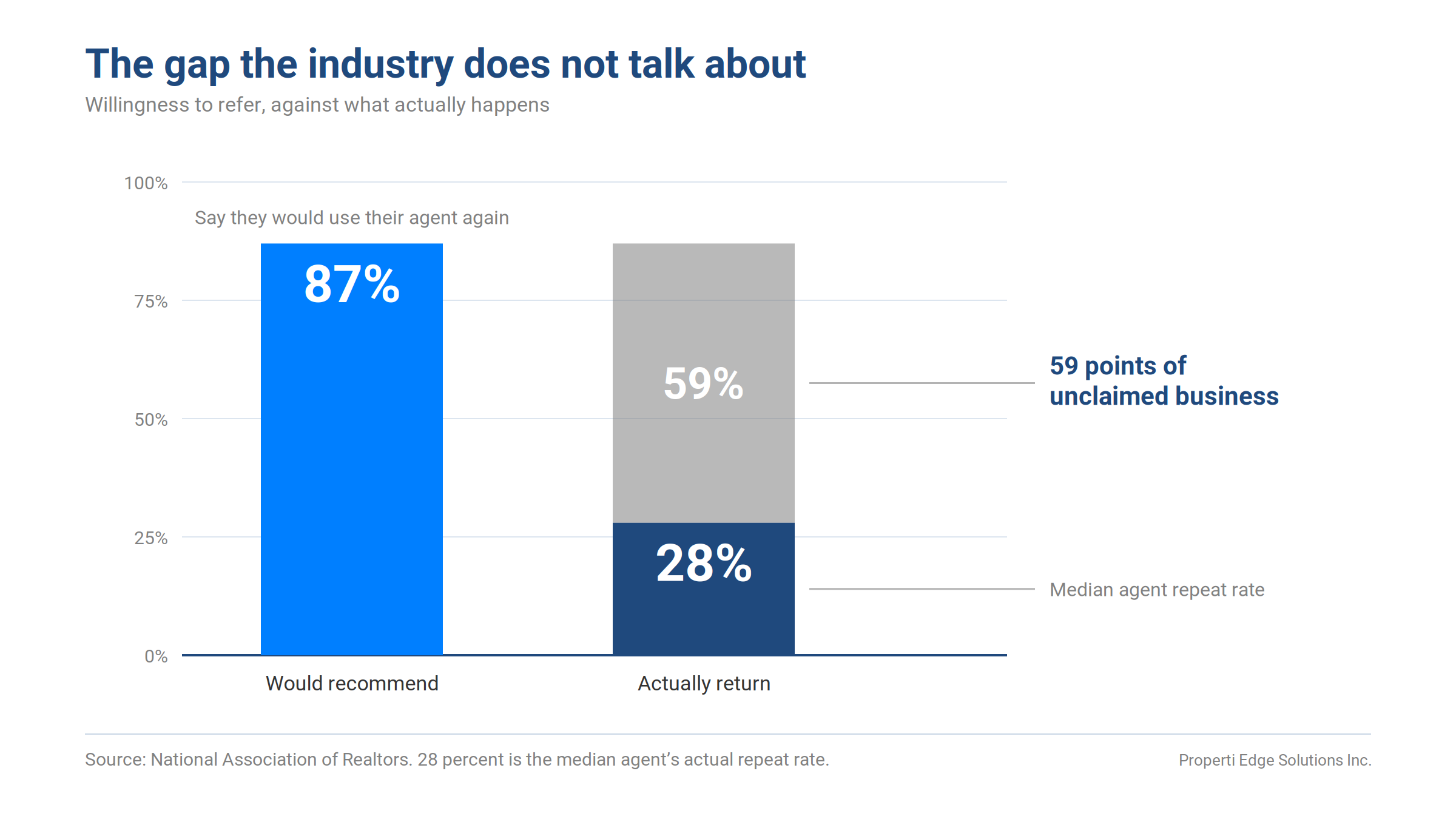
87% of sellers say they would recommend their agent. The median Realtor earns 20% of their business from repeat clients. Our new Canadian whitepaper is about the 67 points in between, and about why closing that gap is a brokerage decision rather than an agent one.
There is a number in the National Association of Realtors research that the industry quotes constantly, and a second number sitting right beside it that almost nobody quotes at all.
The first is that 87% of sellers say they would definitely or probably recommend their agent for future services, and 91% of buyers say they would use their agent again or recommend them. It appears in listing presentations, on brokerage websites, and in a great many conference keynotes. It is a genuinely good number and the profession has earned it.
The second comes from the same organization's Member Profile. The median Realtor earns 20% of their business from repeat clients and customers, and 21% from referrals from past clients and customers.
Those figures describe the same population. Nearly nine in ten clients finish a transaction willing to send you business. One fifth of the median agent's business actually arrives that way. The distance between them is not a rounding error or a measurement artifact. It is the largest single pool of unclaimed business sitting inside your brokerage, and it is already in databases your agents own and your brokerage already paid to acquire.
The gap is not a satisfaction problem
The instinctive reading is that those clients were never as happy as they said. The data says otherwise. In NAR's Generational Trends research, 66% of recent sellers used a referral or the same agent they had worked with in the past, and 51% used the same agent to buy and to sell. On the buyer side, referrals remain the primary method most buyers use to find their agent. Past clients are the single largest source of business in the industry by a wide margin. Satisfaction is not the constraint. Something happens after closing, and loyalty quietly fades.
During a transaction your agent is in constant contact. Afterwards the line goes quiet. The client concludes the agent does not have time for them, and that what felt like a relationship was always just a transaction.
When a friend asks a past client for an agent recommendation eighteen months after their move, that client is not consulting a considered judgment about professional quality. They are consulting memory. An agent they last heard from at closing, or through a seasonal newsletter they did not open, is competing against an agent whose name came up last month for a specific and useful reason. Enthusiasm is what turns a mention into a referral, and enthusiasm decays on a schedule.
This is why the correlation with experience is so stark, and why it should interest you more than it interests your agents. In the Member Profile, agents with two years of experience or less report a median of 0% repeat business and 0% referral business. At three to five years it is 8% and 17%. At six to fifteen years, 22% and 24%. At sixteen years or more, 42% and 29%, a combined 71% of business from people they have already served.
Read that column as a brokerage economics problem rather than a career arc. Your most experienced people are running an advisory playbook manually, imperfectly, and only for the clients they happen to remember. Everyone below them is buying business at retail. The 71% is not a reputation effect that accumulates passively over time. It is what a maintained database looks like, and there is currently no version of it that belongs to the brokerage rather than to the individual.
Relevance, not frequency
The obvious response is to communicate more, and it is the wrong one. Most agents already run some form of past-client program: seasonal newsletters, neighbourhood market summaries, anniversary notes, occasional rate commentary. These are not worthless, but they carry a specific risk that is rarely acknowledged.

A client who opens your spring market update and finds nothing about their property, their equity, or their situation learns something durable, which is that messages from your brokerage can safely be ignored. Every subsequent message is read through that lesson.

The Properti Edge whitepaper models three tiers of engagement: generic, templated personalization, and ultra-personalized advisory. The distinction that matters is not how often the agent makes contact. It is whether the contact contains something the client could not have worked out alone.
What that looks like in practice
Consider a couple planning to downsize from a detached house in Brampton to a condominium in Oakville. Aggregate commentary on the Toronto market would tell them very little, and what it did tell them would be biased toward detached houses.
The sub-markets tell a different story. The figures that follow are illustrative, used to show the shape of the analysis rather than as a current reading of either market. Brampton detached sits at 4.7 months of inventory, a balanced market. Oakville condominiums sit at 9.2, a strong buyer's market. That 4.5-month spread means this household is positioned to sell into relative strength and buy into relative weakness at the same moment, and the window will not stay open indefinitely.
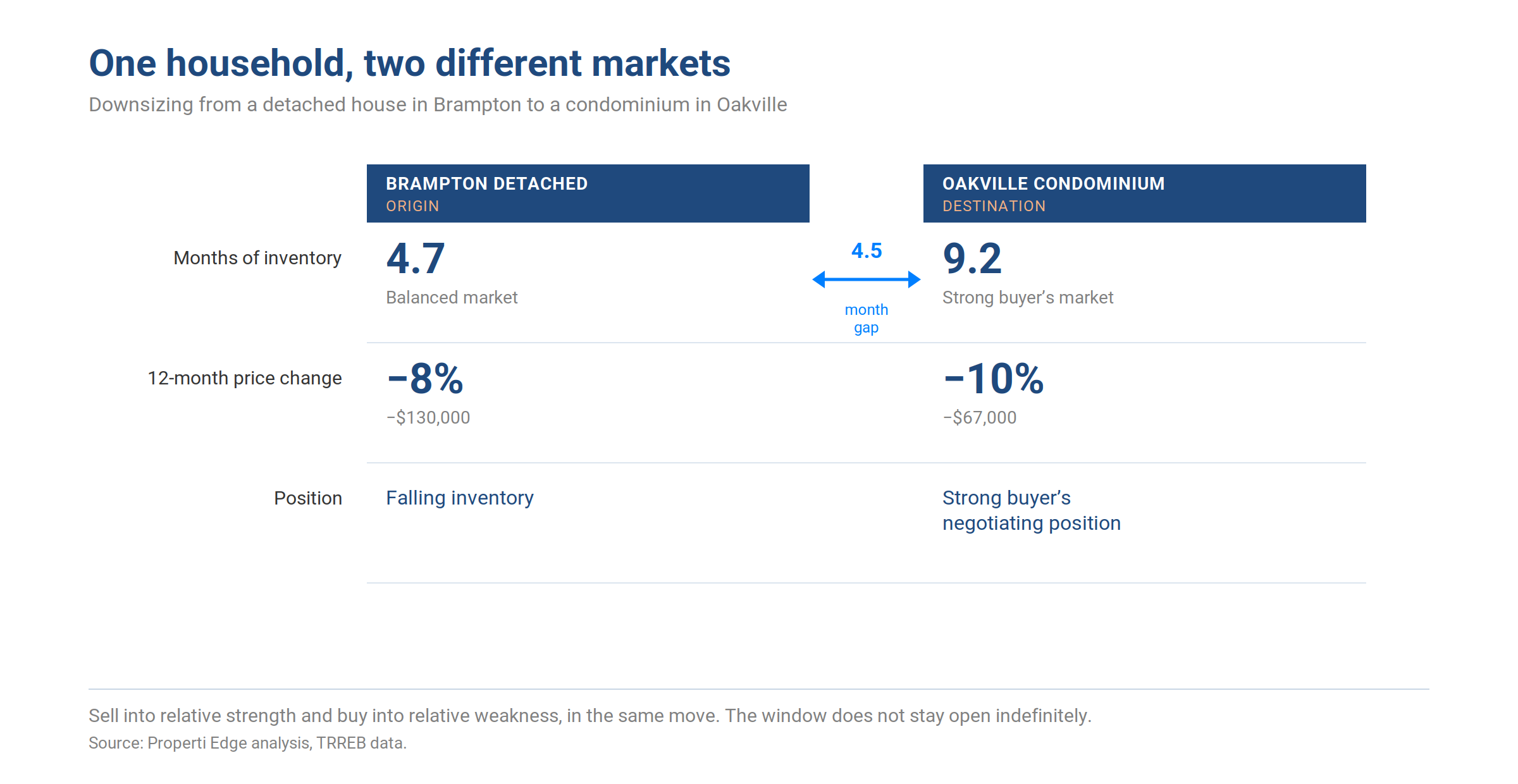
That is not a market update. It is advice, it is specific to one household, and it is the kind of thing a client repeats to other people. The whitepaper works through the same analysis on Greater Vancouver data, from a New Westminster house to a Westside condominium, along with mortgage renewal timing and blend-and-extend opportunities that most homeowners never hear about from anyone.
What it is worth
Modelled against a 250-client database at Greater Toronto parameters, an average sale price of $1.1 million and a listing-side commission of $27,500 in gross commission before splits, the difference between generic and advisory engagement is roughly five additional closed transactions a year per agent. Smaller databases scale down proportionally. For an eight-agent team, on the deliberately conservative assumption of three additional transactions each rather than five, it is roughly $660,000 in gross commission before splits.
Apply your own split structure to that number rather than ours. Whatever share you retain, the more useful observation is what these transactions cost to acquire, which is the subject of the next section.
Those figures are projections rather than observed results, and the whitepaper labels them as such throughout. They are anchored to NAR repeat and referral benchmarks and Canadian market parameters, every input is sourced, and the pilot exists to test them. We would rather publish a number you can audit than a number you have to trust.
The transactions that arrive with no acquisition cost attached
The gross commission is the less interesting half of the arithmetic.
Every other channel your brokerage relies on carries a cost that lands before the deal does. Purchased leads are paid for whether or not they convert. Relocation and network-sourced business arrives with a referral fee already deducted. Portal and platform spend is a fixed monthly commitment against a variable return. And the Member Profile is blunt about what that spend actually produces: the median Realtor received no business at all through paid third-party lead generation, and reported no business generated directly from their own website or social media beyond a low single-digit share.
A transaction that comes from a past client in your own database carries none of that. No referral fee. No lead purchase. No incremental marketing spend. Measured on turnover, an advisory-sourced listing and a purchased-lead listing look identical. Measured on contribution, they are not the same product, and only one of them improves as your database ages.
That is the number worth putting in front of your accountant: not the gross commission line, but the difference in contribution margin between the two channels, multiplied by however many transactions you can move from one to the other.
The recruiting conversation you cannot currently win
There is a second-order effect here that matters more than the commission arithmetic for most brokerages.
Every Broker of Record in this market is defending a split against somebody offering a better one, and that is a competition with no floor. The Member Profile puts median tenure at a current firm at five years, and at four years for sales agents. Whatever you are currently offering, it is holding people for about four years.
The only durable answer to a richer split is a higher production ceiling: an agent earning more on your split than they would on a better split somewhere else. An advisory standard applied across the brokerage does that structurally. Every agent works the same disciplined playbook across their own database, the combined book compounds into a shared recommendation engine, and the pitch to a prospective hire stops being a percentage and becomes a system. Join us and inherit the infrastructure that turns your past clients into next year's pipeline.
It is a particularly strong pitch to the people you most want and can least afford to overpay for. An agent in their third year is sitting at a median of 8% repeat business. You are offering them the thing that takes most agents another decade to build.
Which raises the fair objection, and it deserves a direct answer. If my agents build advisory relationships with their own past clients, am I funding their portability?
The opposite, in practice. An agent working alone builds relationships that live in their head and leave when they do. A brokerage operating an advisory standard builds an institutional asset: the profiles, the market history, and the reputation attach to the brand, and the client's experience of being well advised is an experience of your brokerage. The relationships were always portable. What was never portable, until now, was the system that made them productive.
Why almost nobody does this
Here is the part that usually goes unsaid in a document like this.
The advisory model is not difficult to understand, and it is not new. Agents have been told to add value between transactions for thirty years. The reason it remains rare is that the work is linear. Producing a genuinely specific insight for one household takes an hour of skilled attention, and there is no version of the week in which one agent does that for 250 households.
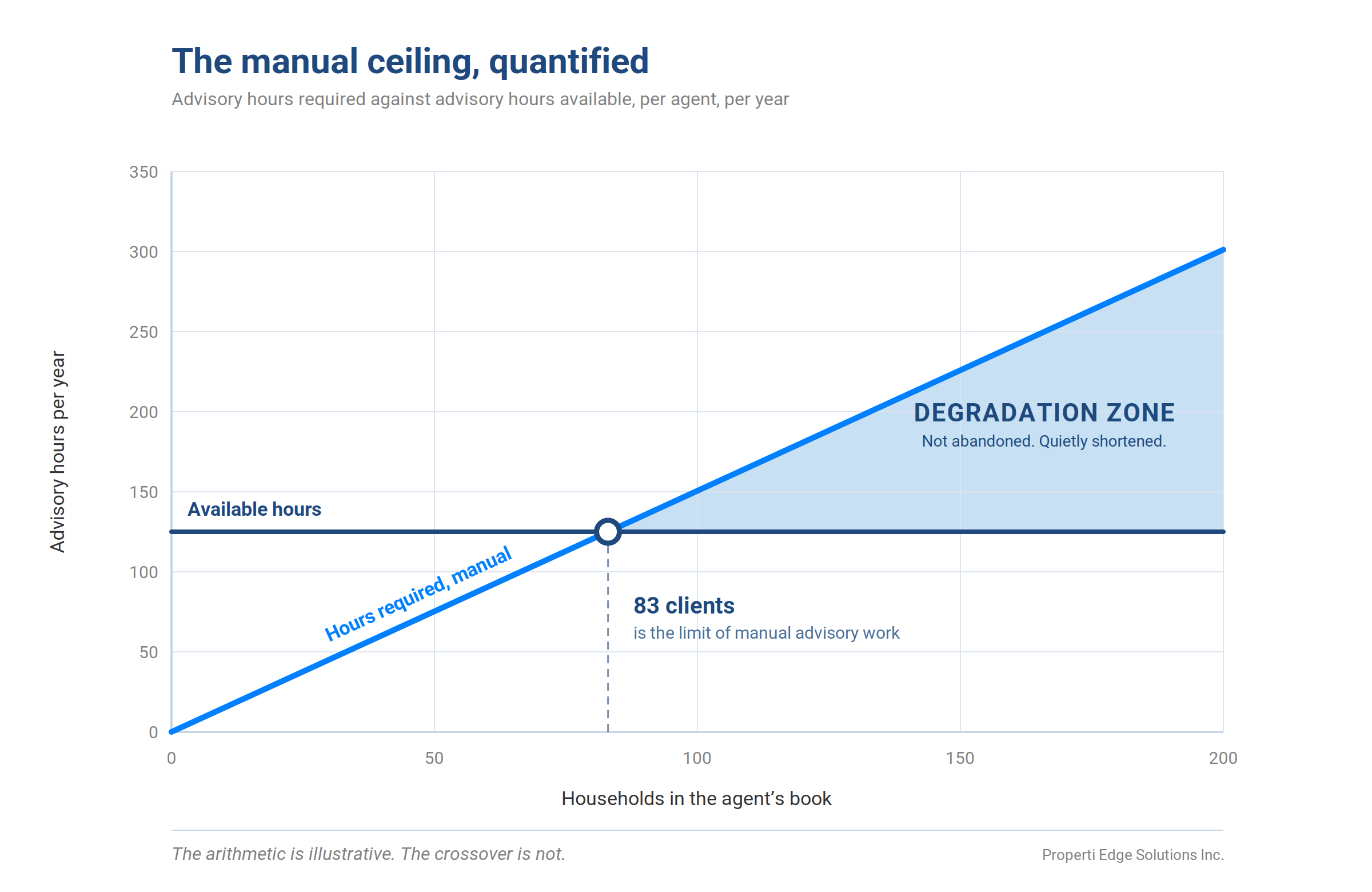
The failure mode is the part that should concern a Broker of Record, because it is invisible from where you sit. What happens is not abandonment but degradation. The profile conversation gets shortened. The market check gets skipped for the clients whose sub-markets are inconvenient to look up. The personalized note becomes a template with a first name in it. Within two quarters the program is a newsletter again, and the client has correctly stopped reading.
None of that shows up in an activity metric. The touches still happen. The dashboard still looks fine. You find out two years later, when the pipeline is entirely portal-sourced and nobody can say exactly when that started.
You can mandate advisory contact. You cannot supervise it. That is the actual problem Properti Edge is built to solve. Not the idea, which is available to anyone. The execution, at a scale and a standard where it stops being possible by hand.
The New Listings You Never Competed For
How past-client advisory turns goodwill into new business, cuts lead spend, and gives team leads a recruiting story that splits cannot match
The Founding Design Partner Program
Our prototype is live and built for Canada. We are opening the founding partner program now, and we are looking for brokerages and teams with an established book who want to test these numbers against their own database rather than take ours on faith.
Read the whitepaper first. If the argument holds up, the conversation is worth having.
