The Cheapest Instructions in Your Agency Are the Ones You Already Own
The Cheapest Instructions in Your Business Are the Ones You Already Own
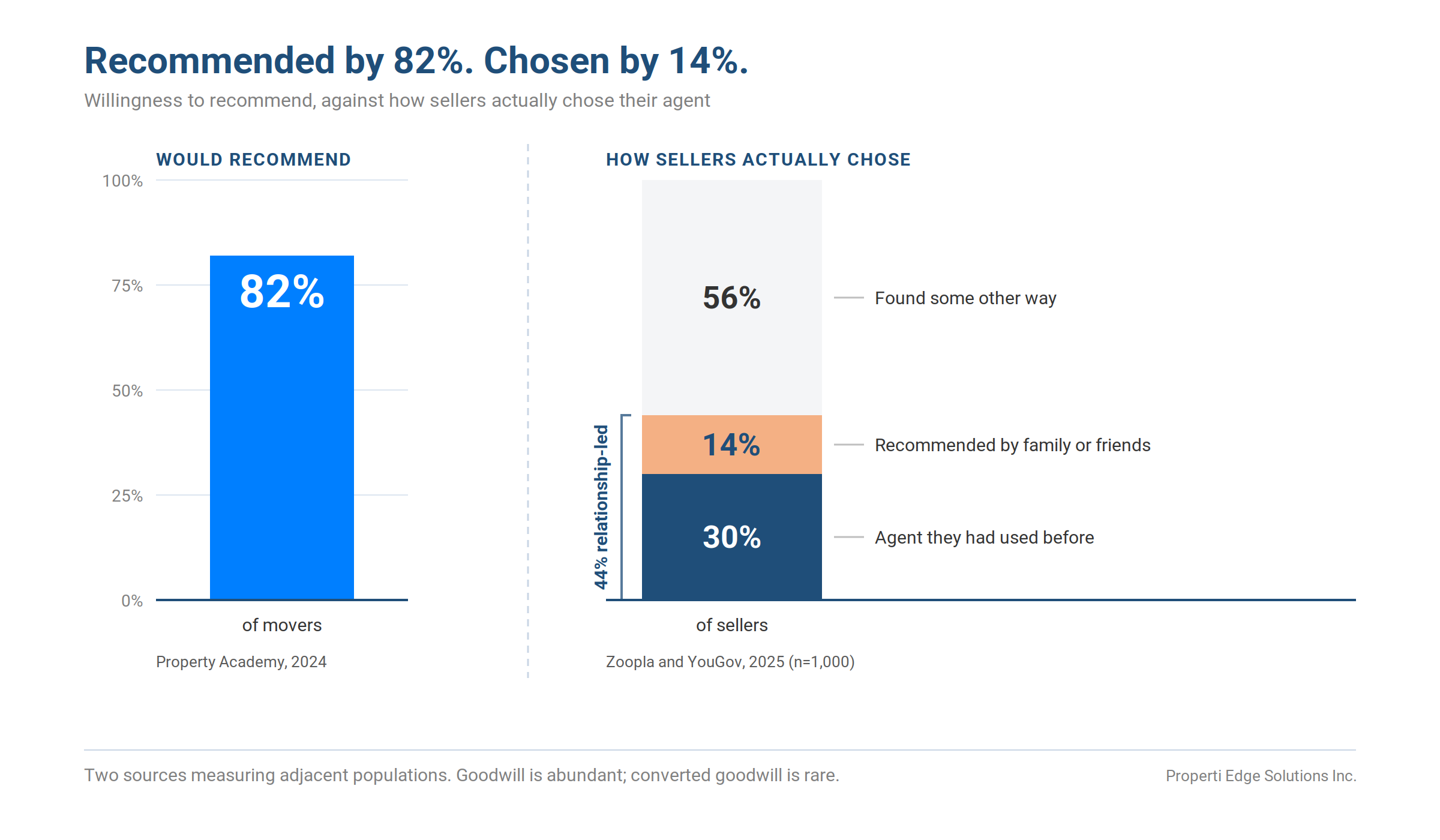
82% of movers say they would recommend their estate agent. Only 14% of sellers actually choose one that way. Our new UK whitepaper is about the distance between those two numbers, and about why closing it is an agency decision rather than a negotiator one.
There is a figure the industry quotes with some justification, and a second figure sitting beside it that almost nobody puts in the same sentence.
The first comes from the Property Academy's 2024 Home Moving Trends survey: 82% of movers say they would recommend their estate agent. It appears on agency websites, in listing presentations, and in a good deal of conference material. It is a real number and the profession has earned it.
The second comes from Zoopla and YouGov, who in 2025 asked a thousand homeowners who had sold in the previous five years how they chose their agent. Only 14% had gone with an agent recommended by family or friends. A further 30% used an agent they had worked with before.
Goodwill, in other words, is abundant. Converted goodwill is rare. The distance between the two is not a service problem, and it is not a problem any individual negotiator can be held responsible for solving. It is the largest pool of unclaimed instructions sitting inside your business, and it is already in databases your agency has paid to acquire.
Why the gap opens
The instinctive reading is that those movers were being polite, and that the satisfaction figure is softer than it looks.
The rest of the evidence does not support that. Prior relationships and recommendations together account for 44% of how sellers choose an agent, which already makes the existing client book the largest single source of instructions in the industry. The willingness is there and it is doing real work. What fails is the conversion of willingness into an actual name at the moment somebody asks.
That moment is the problem. When a colleague mentions they are thinking of moving, the person they ask is not conducting a considered assessment of professional competence. They are searching their memory. An agent last heard from at completion, or through a quarterly newsletter that went unopened, is competing against whoever happens to be top of mind. Enthusiasm decays, and it decays on a predictable schedule.
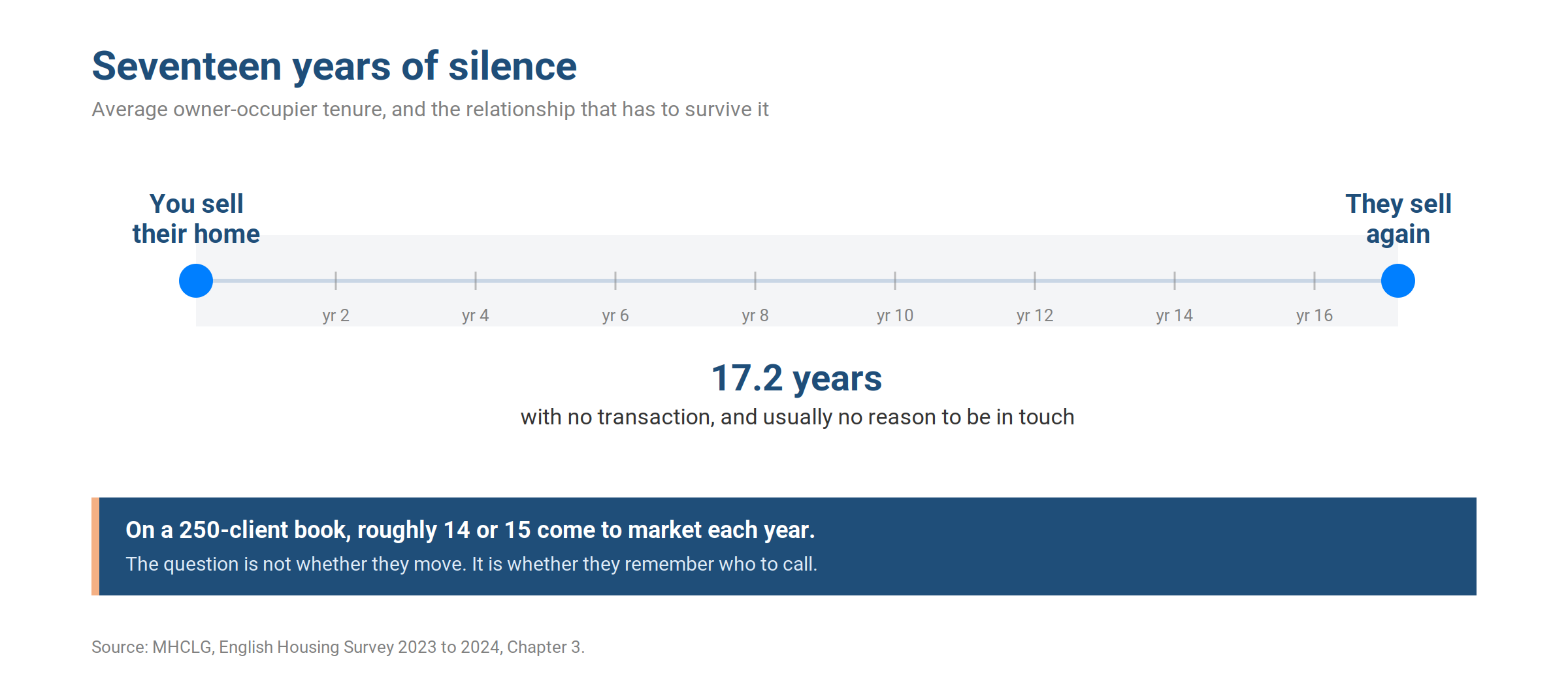
The tenure data makes this worse in the UK than almost anywhere. English Housing Survey figures put average owner-occupier tenure at 17.2 years. On a book of 250 past clients, roughly 14 or 15 come to market in any given year. The gap between transactions is not months. It is long enough for a relationship to disappear entirely unless something actively maintains it.
Read that as a management problem rather than a service one. Set the seventeen years against your own retention. Industry commentary puts annual staff turnover in UK estate agencies at roughly 30% to 35%, which implies an average tenure of about three years. That is an indicative calculation rather than a measured national figure, but the order of magnitude is the point: the client relationship outlasts the person who made it by a factor of five. The relationship has to be held by the business, because there is no realistic version of this in which it is held by an individual.
The industry knows it has a communication problem
This is not a subtle finding hiding in the data. Poor communication is named by 51% of movers as the single biggest stressor of moving home, and 97% of homeowners rate responsiveness as essential or very important when choosing an agent. And on the supply side: 45% of agents cite lack of time as their biggest marketing frustration, and 92% of agency marketing is run in-house by people whose main job is something else entirely. Demand for advisory contact and the capacity to supply it are moving in opposite directions. That is the whole problem in two sentences, and the second sentence is about resourcing, which is yours to set.
Relevance, not frequency
The obvious response is to communicate more often, and it is the wrong one. Most agencies already run something: seasonal newsletters, area market updates, completion anniversary notes. These are not worthless, but they carry a cost that rarely gets counted. A client who opens your spring market update and finds nothing about their property, their equity, or their circumstances learns something durable, which is that messages from your agency can safely be ignored. Every message after that is read through that lesson. DMA UK benchmarks put the sector's unique click rate at 2.1%, which is roughly what learning that lesson looks like in aggregate. The whitepaper models three tiers: generic, templated personalisation, and ultra-personalised advisory. What separates them is not how often the agent makes contact. It is whether the contact contains something the recipient could not have worked out for themselves.
What that looks like in practice
Take a couple thinking about downsizing from a house in Surrey to a flat in Richmond.
Aggregate commentary on the UK market tells them very little, and what it does tell them is skewed toward the wrong property type. The two sub-markets tell a different story. Illustratively, their Surrey house sits at 6.2 months of supply, a market only marginally against a seller, while Richmond flats sit at 10.6, a strong buyer's market. That 4.4-month spread means this household is positioned to sell into relative strength and buy into relative weakness in the same move, and the window will not stay open indefinitely.
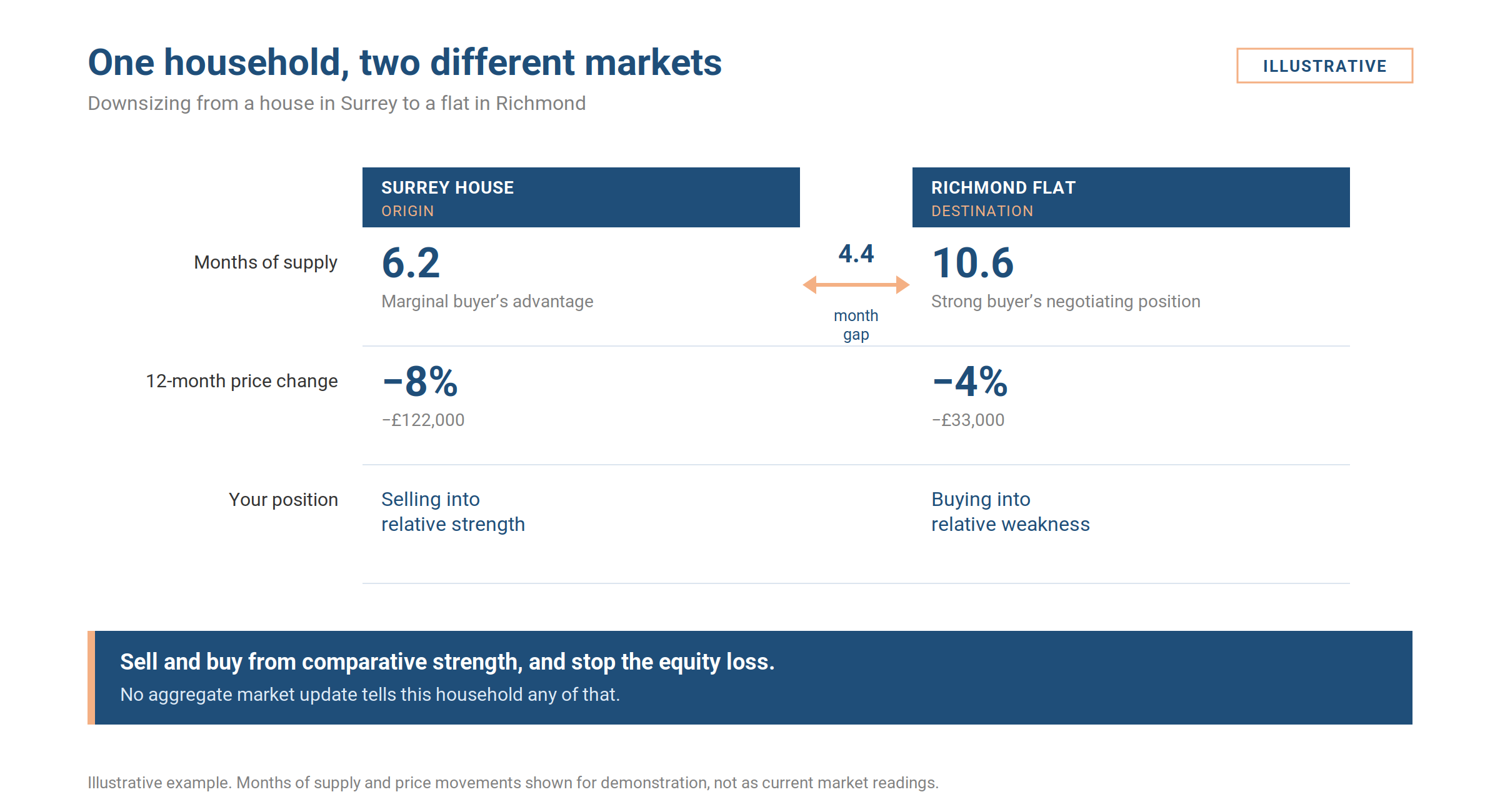
Layer the price movement on top and the case sharpens. Their house is down roughly 8% over twelve months, which on their value is about £122,000 of equity. The Richmond flat they are moving into is down about 4%, or £33,000. Waiting costs them more on the sale than it saves them on the purchase, which is precisely the calculation no household runs unprompted.
That is not a market update. It is advice, it is specific to one household, and it is the kind of thing people repeat to other people. The whitepaper works through the same analysis alongside fixed rate expiry timing, term extension opportunities, and lease length thresholds that most leaseholders never hear about from anyone until it is expensive.
What the gap is worth at branch level
Modelled on a 250-client book at Greater London parameters, with an average asking price of £687,080 and a 1.5% sole-agency fee giving £10,306 per instruction, the difference between generic and advisory engagement is roughly five to six additional instructions a year per agent. Smaller books scale down proportionally. For an eight-agent branch, on the deliberately conservative assumption of three additional instructions each, it is roughly £247,000 in gross commission.
Two qualifications belong with those figures rather than in a footnote. It is a London model, and substituting the national average commission of £5,642 brings the incremental figure down to somewhere around £28,000 to £34,000 per agent. And only the difference between tiers is attributable to the outreach; the natural sellers in the book exist either way.
Apply your own cost base to that number rather than ours. Whatever share survives it, the more useful observation is what these instructions cost to win, which is the subject of the next section.
The figures are projections rather than observed results, and the whitepaper labels them as such throughout. Every input is sourced and the arithmetic is shown, so you can re-run it on your own average price rather than borrowing ours. We would rather publish a number you can audit than a number you have to trust.
The instructions that arrive with no acquisition cost attached
The gross commission is the less interesting half of the arithmetic.
Almost every other source of instructions your business relies on carries a cost that lands before the deal does. Portal listings are a fixed monthly commitment against a variable return, and they are charged whether the property sells, withdraws, or sits. Purchased vendor leads are paid for on delivery rather than on completion. Network and relocation business arrives with a fee already deducted. Local press and canvassing spend is committed in advance of any instruction it produces.
Portal spend alone already consumes more than 11% of the typical firm's income, and 61% of agents say they are unconvinced by the value it delivers. That is a large, fixed, disliked line item, and it is the one your competitors are also paying, which is precisely why it buys no advantage.
An instruction that comes from a past client in your own book carries none of that. No portal attribution. No lead purchase. No referral fee. Measured on turnover, an advisory-sourced instruction and a portal-sourced instruction look identical. Measured on contribution, they are not the same product, and only one of them improves as your book ages.
That is the number worth putting in front of your finance director: not the gross commission line, but the difference in contribution margin between the two channels, multiplied by however many instructions you can move from one to the other.
The appraisal you never have to win
There is a second-order effect that compounds the first.
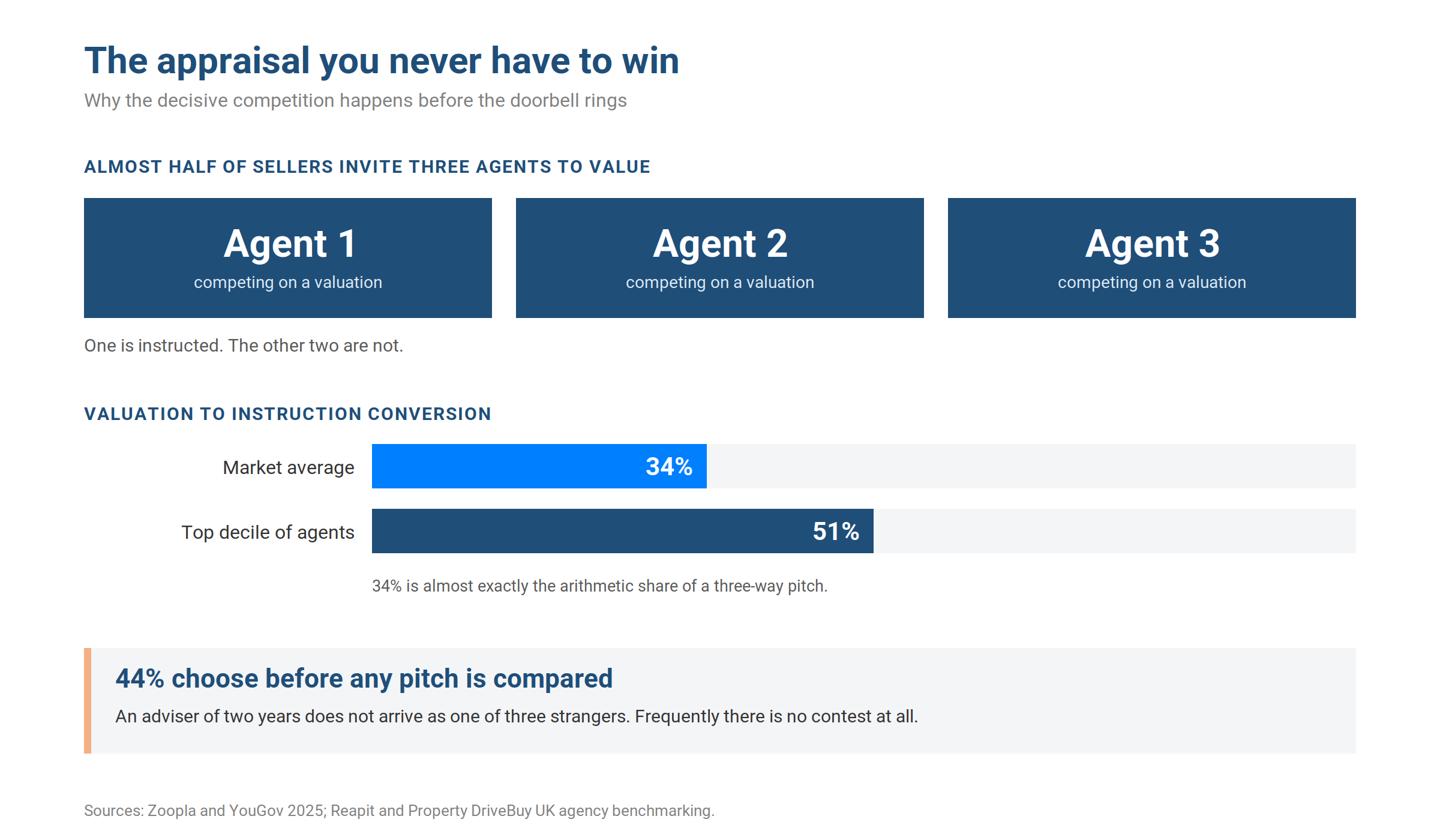
Almost half of UK sellers, 49% of them, invite three agents to value their home before instructing one. Industry benchmarking puts average valuation-to-instruction conversion at 34%, which is almost exactly the arithmetic share of a three-way pitch. Even the top decile of agents converts only 51%. By the time the doorbell rings, the shortlist is already drawn, and the decision too often goes to whoever quotes the most optimistic figure.
That is a structural problem with how your business currently wins work. You are paying for the appraisal, paying for the lead that produced it, and losing two in three of them to a contest decided on valuation optimism rather than on competence.
But the decisive competition happened earlier, in who got shortlisted at all. An agent who has spent two years as a household's property wealth advisor does not arrive as one of three strangers competing on a valuation. Frequently there is no competition at all.
This matters more in a market like the current one. London is the hardest region in the country in which to sell, at an average of 73 days to find a buyer and asking prices down 3.1% year on year. When every instruction is harder to win, the instructions that arrive already won matter most.
The recruiting conversation you cannot currently win
Every principal in this market is defending a package against somebody offering a better one, and that is a competition with no floor. Whatever you are currently paying, someone will pay more, and the people most worth keeping are the ones most likely to be asked. Turnover of 30% to 35% a year is what that competition looks like when you lose it repeatedly.
The only durable answer to a richer package is a higher production ceiling: a negotiator earning more on your terms than they would on better terms somewhere else. An advisory standard applied across the agency does that structurally. Every negotiator works the same disciplined playbook across their own book, the combined book compounds into a shared recommendation engine, and the pitch to a prospective hire stops being a number and becomes a system. Join us and inherit the infrastructure that turns your past clients into next year's pipeline.
It is a particularly strong pitch to the people you most want and can least afford to overpay for. Someone in their third year has a book that is technically large enough to produce instructions and practically too young to have produced any. You are offering them the thing that otherwise takes most of a career to build.
Which raises the fair objection, and it deserves a direct answer. If my negotiators build advisory relationships with their own past clients, am I funding their portability?
The opposite, in practice. A negotiator working alone builds relationships that live in their head and leave when they do. An agency operating an advisory standard builds an institutional asset: the profiles, the market history, and the reputation attach to the brand, and the client's experience of being well advised is an experience of your agency. The relationships were always portable. What was never portable, until now, was the system that made them productive.
Why almost nobody does this
Here is the part that usually goes unsaid in a document like this one.
The advisory model is not difficult to understand and it is not new. Agents have been told to add value between transactions for thirty years. It remains rare because the work is linear. Producing a genuinely specific insight for one household takes an hour of skilled attention, and there is no version of the week in which one negotiator does that across a full book.
The failure mode is the part that should concern a principal, because it is invisible from where you sit. What happens is not abandonment but degradation. The profile conversation gets shortened. The market check gets skipped for the clients whose sub-markets are inconvenient to look up. The personalised note becomes a template with a first name in it. Within two quarters the programme is a newsletter again, and the client has correctly stopped reading.
None of that shows up in an activity metric. The touches still happen. The dashboard still looks fine. You find out two years later, when the pipeline is entirely portal-sourced and nobody can say exactly when that started.
You can mandate advisory contact. You cannot supervise it. That is the actual problem Properti Edge is built to solve. Not the idea, which is available to anyone who wants it. The execution, at a scale and a standard where it stops being possible by hand.
The New Instructions You Never Pitched For
How past-client advisory turns goodwill into new business, cuts lead spend, and gives principals a recruiting story that splits cannot match
The Founding Design Partner Programme
We are opening a free founding-partner programme to the first ten London agencies. Our prototype is live and built for Canada, and we are now localising it for the UK market. Founding partners shape what the product becomes, and we are looking for agencies with an established book who want to test these numbers against their own database rather than take ours on faith.
Read the whitepaper first. If the argument holds up, the conversation is worth having.
