Satisfied Clients Are Not Referring Clients
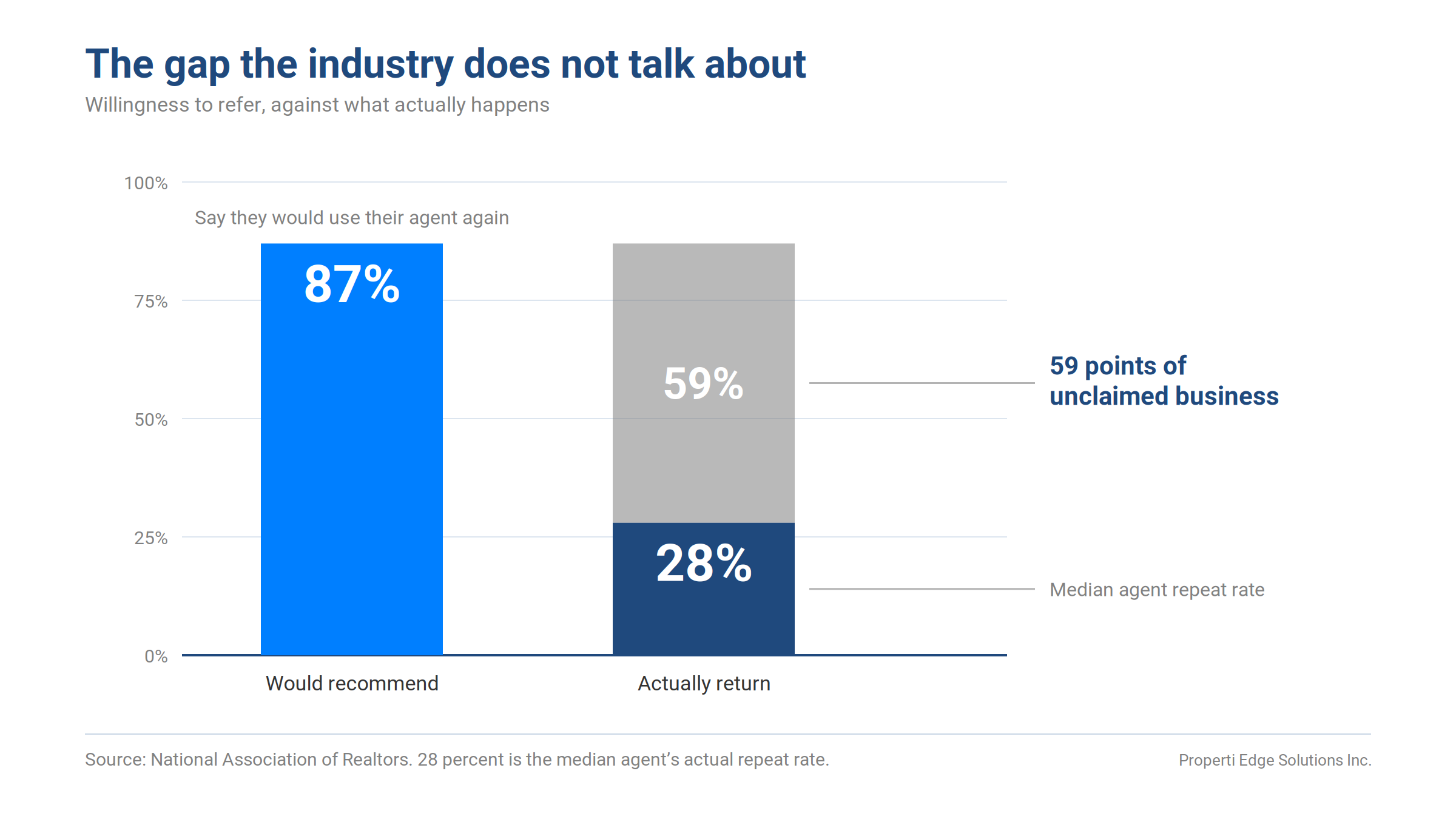
87% of sellers say they would use their agent again or recommend them. The median agent's actual repeat rate is 28%. Our new Canadian whitepaper is about the 59 points in between.
There is a number in the National Association of Realtors research that the industry quotes constantly, and a second number sitting right beside it that almost nobody quotes at all.
The first is that 87% of sellers say they would use their agent again or recommend them. It appears in listing presentations, on brokerage websites, and in a great many conference keynotes. It is a genuinely good number and the profession has earned it.
The second is that the median agent's actual repeat rate is 28%.
Those two figures describe the same population. Nearly nine in ten clients finish a transaction willing to send you business. Fewer than three in ten do. The distance between them is not a rounding error or a measurement artifact. It is the largest single pool of unclaimed business available to a Canadian Realtor, and it sits inside a database you already own and already paid to acquire.
The gap is not a satisfaction problem
The instinctive reading is that those clients were never as happy as they said. The data says otherwise. Referrals and prior relationships account for 49% of buyers and 43% of sellers finding their agent, which makes past clients the single largest source of business in the industry by a wide margin. Satisfaction isn’t the constraint. Something happens after closing, and loyalty quietly fades.
During a transaction you’re in constant contact. Afterwards the line goes quiet. The client concludes you don’t have time for them, and that what felt like a relationship was always just a transaction to you.
When a friend asks a past client for an agent recommendation eighteen months after their move, that client is not consulting a considered judgment about professional quality. They are consulting memory. An agent they last heard from at closing, or through a seasonal newsletter they did not open. That memory is competing against an agent whose name came up last month for a specific and useful reason. Enthusiasm is what turns a mention into a referral, and enthusiasm decays on a schedule.
This is why the correlation with experience is so stark. The median agent draws 20% of business from repeat clients and 21% from referrals. Agents with sixteen or more years in the business draw 42% and 29%, a combined 71% from people they have already served. That is not a reputation effect accumulating passively over time. It is what a maintained book looks like.
Relevance, not frequency
The obvious response is to communicate more, and it is the wrong one. Most agents already run some form of past-client program: seasonal newsletters, neighbourhood market summaries, anniversary notes, occasional rate commentary. These are not worthless, but they carry a specific risk that is rarely acknowledged.
A client who opens your spring market update and finds nothing about their property, their equity, or their situation learns something durable, which is that messages from you can safely be ignored. Every subsequent message is read through that lesson.
The Properti Edge whitepaper models three tiers of engagement: generic, templated personalization, and ultra-personalized advisory. The distinction that matters is not how often the agent makes contact. It is whether the contact contains something the client could not have worked out alone.
What that looks like in practice
Consider a couple planning to downsize from a detached house in Brampton to a condominium in Oakville. Aggregate commentary on the Toronto market would tell them very little, and what it did tell them would be biased toward detached houses.
The sub-markets tell a different story. Brampton detached sits at 4.7 months of inventory, a balanced market. Oakville condominiums sit at 9.2, a strong buyer's market. That 4.5-month spread means this household is positioned to sell into relative strength and buy into relative weakness at the same moment, and the window will not stay open indefinitely.
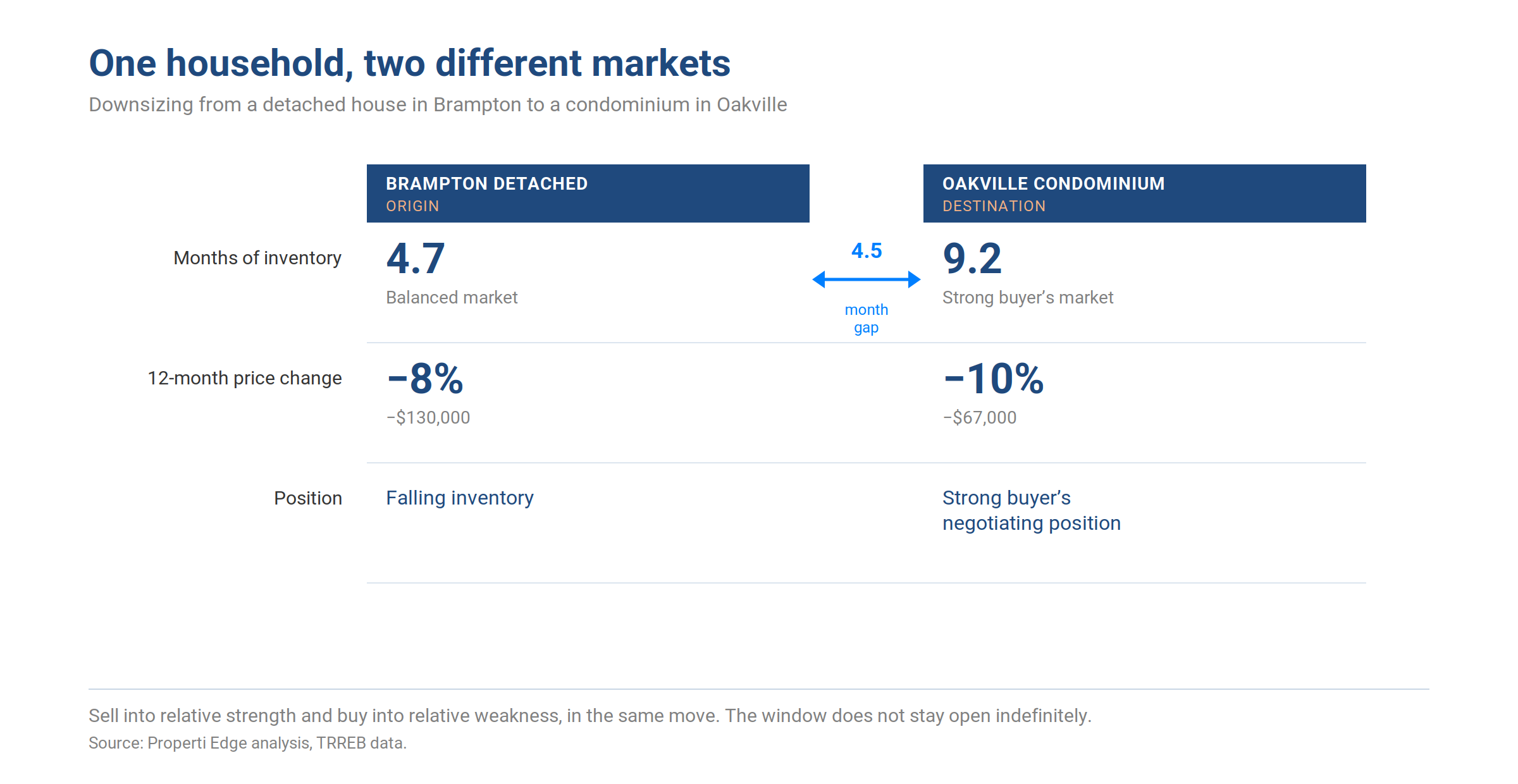
That is not a market update. It is advice, it is specific to one household, and it is the kind of thing a client repeats to other people. The whitepaper works through the same analysis on Greater Vancouver data, from a New Westminster house to a Westside condominium, along with mortgage renewal timing, and blend-and-extend opportunities that most homeowners never hear about from anyone.
What it is worth
Modelled against a 250-client database at Greater Toronto parameters, an average sale price of $1.1 million and a listing-side commission of $27,500, the difference between generic and advisory engagement is roughly five additional closed transactions a year, or about $137,000 in gross commission per agent. For an eight-agent team, on deliberately conservative assumptions of three additional transactions each rather than five, it is roughly $660,000.
Those figures are projections rather than observed results, and the whitepaper labels them as such throughout. They are anchored to NAR repeat and referral benchmarks and Canadian market parameters, every input is sourced, and the pilot exists to test them. We would rather publish a number you can audit than a number you have to trust.
Why almost nobody does this
Here is the part that usually goes unsaid in a document like this.
The advisory model is not difficult to understand, and it is not new. Agents have been told to add value between transactions for thirty years. The reason it remains rare is that the work is linear.
Producing a genuinely specific insight for one household takes an hour of skilled attention, and there is no version of the week in which one agent does that for four hundred households.
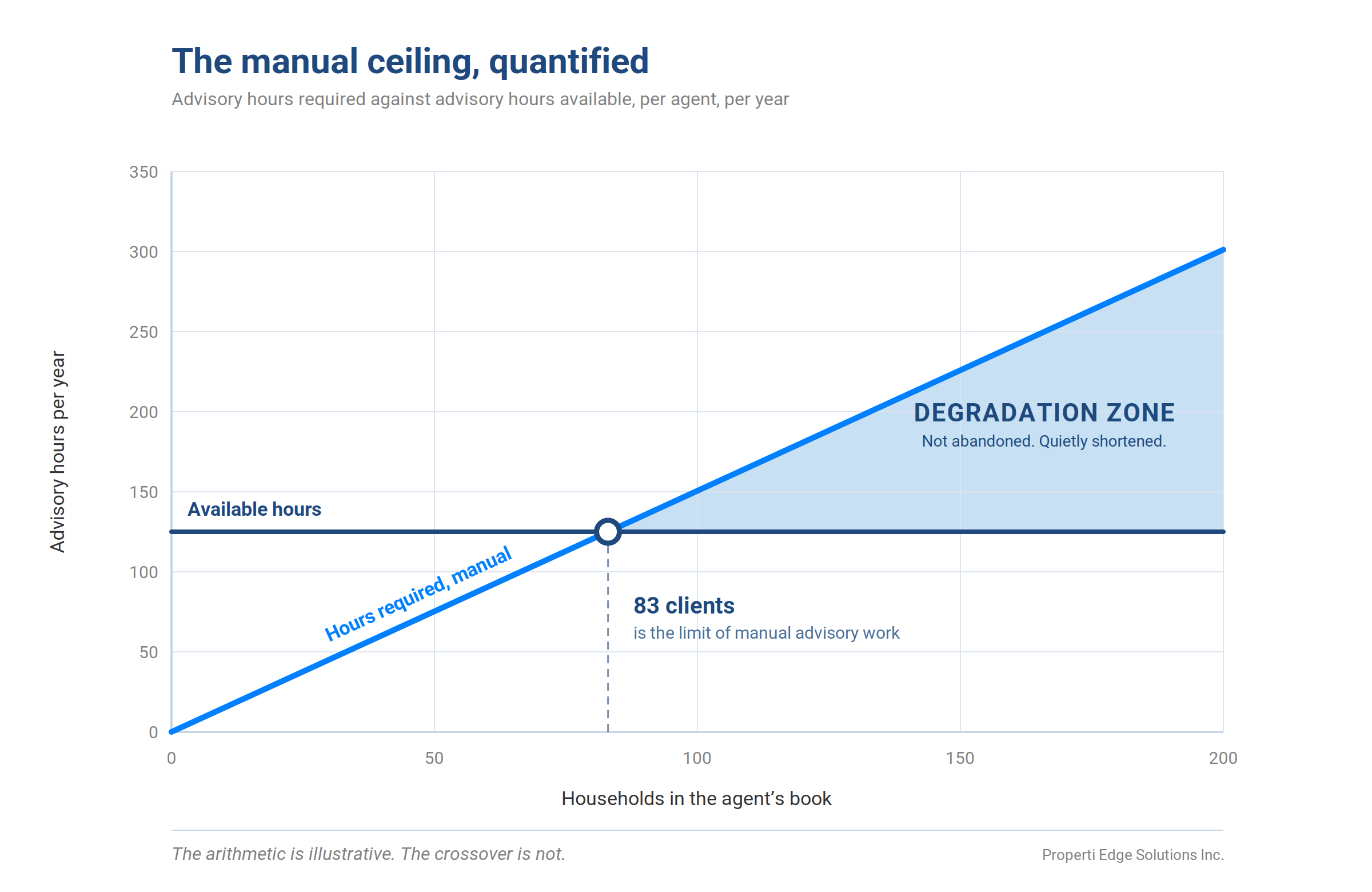
What happens instead is not abandonment but degradation: the profile conversation gets shortened, the market check gets skipped for the clients whose sub-markets are inconvenient to look up, and the personalized note becomes a template with a first name in it. Within two quarters the program is a newsletter again, and the client has correctly stopped reading.
That is the actual problem Properti Edge is built to solve. Not the idea, which is available to anyone. The execution at a scale where it stops being possible by hand.
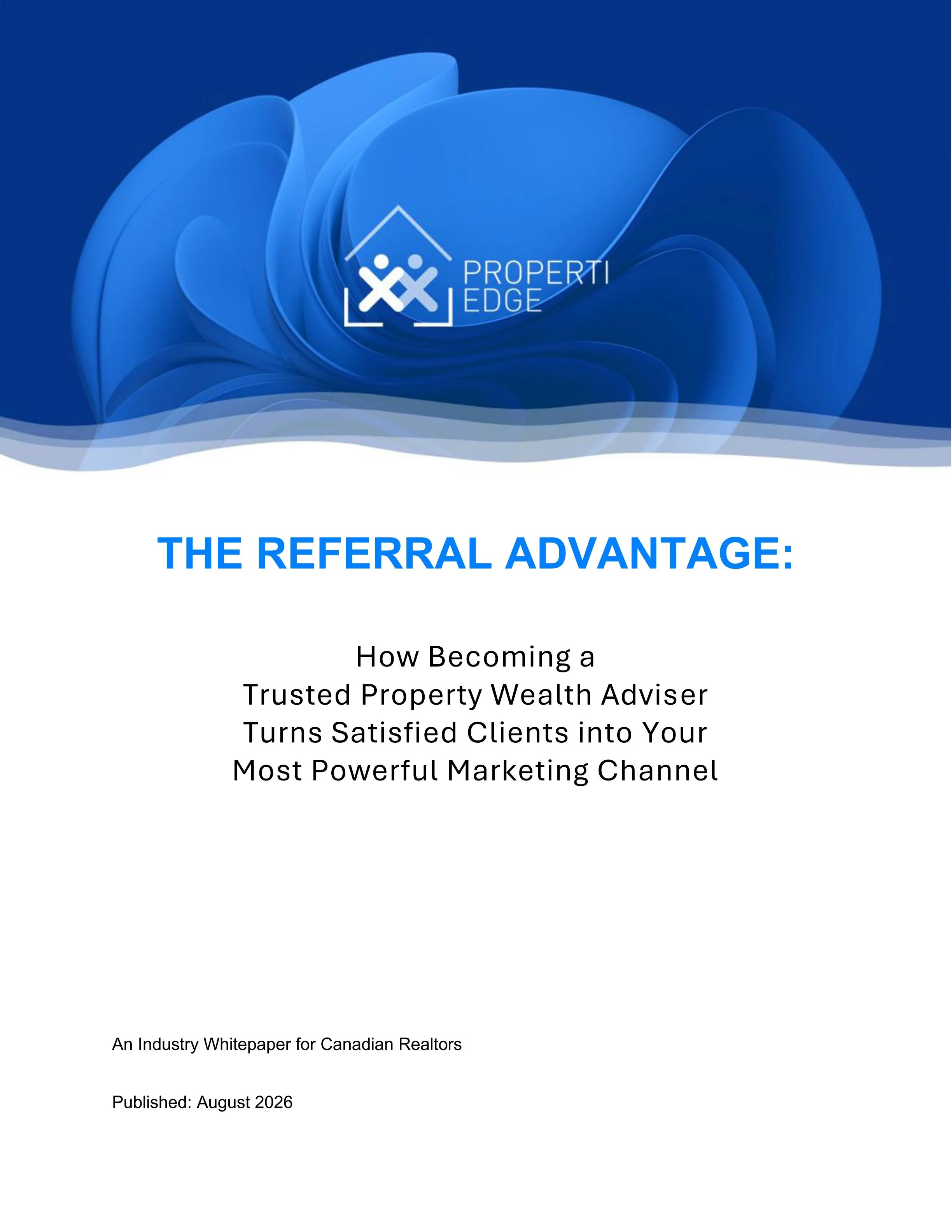
The Referral Advantage:
How Becoming a Trusted Property Wealth Advisor Turns Satisfied Clients into Your Most Powerful Marketing Channel. Published August 2026. Every statistic is sourced, and the sources are listed.
The pilot
The platform is live and in production with agents and brokerages across Canada. We are expanding the Canadian pilot now, and we are looking for agents and teams with an established book who want to test these numbers against their own database rather than take ours on faith.
Read the whitepaper first. If the argument holds up, the conversation is worth having.
